Small Environmental Changes Can Make a Big Difference
Small Environmental Changes Can Make a Big Difference
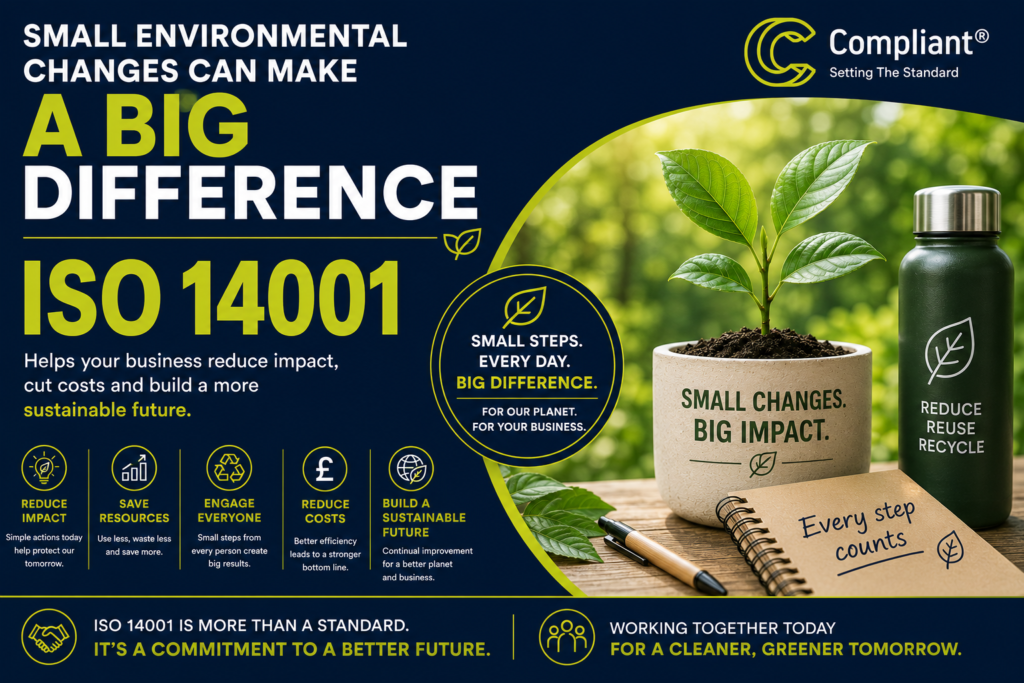
Many businesses believe improving their environmental performance means making expensive changes. The truth is often much simpler.
When organisations hear the words environmental management, they often picture costly equipment, large-scale projects or major changes to the way they work.
That assumption stops many businesses from taking the first step.
In reality, meaningful environmental improvements are often built through small actions repeated every day.
Turning off equipment when it is not being used.
Reducing unnecessary printing.
Managing waste more effectively.
Choosing reusable materials where possible.
Improving energy efficiency.
On their own, these changes may seem small.
Together, they can reduce costs, improve efficiency and create a workplace that is better for both the environment and the business.
This is exactly what ISO 14001 encourages.
Rather than expecting organisations to become perfect overnight, ISO 14001 provides a practical framework for continual improvement. It helps businesses identify opportunities, reduce their environmental impact and make better decisions over time.
In this blog, we will explore why small environmental improvements matter, how they support long-term business success and why the benefits of an ISO consultant’s support can make implementing ISO 14001 much easier.
What Is ISO 14001?
ISO 14001 is the international standard for Environmental Management Systems.
Its purpose is to help organisations understand how their activities affect the environment and provide a structured way to reduce that impact.
It is not about expecting businesses to eliminate every environmental issue overnight.
Instead, it encourages continual improvement.
Every organisation has opportunities to improve.
Whether you work in manufacturing, construction, engineering, retail or professional services, there are always practical ways to reduce waste, improve efficiency and use resources more responsibly.
That is why ISO 14001 is suitable for organisations of every size.
Why Small Changes Matter
Many organisations delay environmental improvements because they believe they need a large budget.
Often, that is not the case.
Small improvements are usually easier to introduce.
Employees understand them.
Managers can monitor them.
The results build over time.
For example:
- Switching off lights in empty rooms.
- Monitoring energy use.
- Recycling materials correctly.
- Reducing paper waste.
- Ordering only what is needed.
- Preventing unnecessary packaging.
- Maintaining equipment to improve efficiency.
None of these actions are complicated.
Yet together they can reduce waste, lower operating costs and improve environmental performance.
This is one of the strengths of ISO 14001.
It encourages organisations to look for practical improvements that become part of everyday working life.
Environmental Responsibility Starts with Leadership
Like many ISO standards, success begins with leadership.
Employees often follow the example set by managers.
If leaders demonstrate that environmental responsibility matters, employees are much more likely to support new initiatives.
This does not require dramatic announcements.
Sometimes it is as simple as asking better questions.
Can we reduce waste?
Can we reuse materials?
Can we improve this process?
Could we use less energy?
When leaders encourage these conversations, continual improvement becomes part of the organisation’s culture.
Every Employee Can Make a Difference
One of the greatest strengths of ISO 14001 is that everyone can contribute.
Environmental improvement is not the responsibility of one department.
Small actions carried out by every employee create significant long-term results.
When people understand why changes matter, they become more engaged.
They begin identifying opportunities that management may never have noticed.
This creates a workplace where improvement becomes everyone’s responsibility.
Environmental Improvements Often Reduce Costs
Many organisations first consider ISO 14001 because customers ask for it.
Others need it when bidding for contracts.
While these are important reasons, many businesses discover another major benefit.
Reducing waste often reduces costs.
Using less energy lowers utility bills.
Reducing material waste improves efficiency.
Better planning reduces unnecessary purchasing.
Improved maintenance extends equipment life.
Good environmental management is often good business management.
Continual Improvement Is the Goal
ISO 14001 does not expect perfection.
It expects progress.
Businesses grow.
Technology changes.
New environmental opportunities appear.
Organisations that review their performance regularly are better placed to adapt.
Small improvements made consistently often achieve more than one large project that is never maintained.
That is why continual improvement sits at the heart of ISO 14001.
The Benefits of an ISO Consultant’s Support
Many organisations want to improve their environmental performance but are unsure where to begin.
This is where the benefits of an ISO consultant’s support become valuable.
An experienced consultant can help organisations:
- Understand the requirements of ISO 14001.
- Identify environmental aspects and impacts.
- Build practical management systems.
- Reduce unnecessary paperwork.
- Prepare for certification audits.
- Develop achievable environmental objectives.
- Create systems that support continual improvement.
- Avoid common implementation mistakes.
Perhaps most importantly, an ISO consultant helps businesses develop systems that fit the way they already work, making environmental improvements easier to maintain over the long term.
Common Mistakes Businesses Make
Some organisations unintentionally make environmental management more difficult than it needs to be.
Common mistakes include:
- Trying to change everything at once.
- Creating unnecessary paperwork.
- Not involving employees.
- Failing to measure progress.
- Ignoring small improvements because they seem insignificant.
- Treating ISO 14001 as a one-off project rather than an ongoing commitment.
Avoiding these mistakes allows businesses to make steady, sustainable progress.
Final Thoughts
Protecting the environment does not always begin with major investment.
It often begins with one small decision.
Then another.
Then another.
Over time, those improvements become part of the way an organisation works.
That is the philosophy behind ISO 14001.
Small changes.
Continual improvement.
Long-term success.
Supported by strong leadership and the benefits of an ISO consultant’s support, organisations can build environmental management systems that reduce waste, improve efficiency and demonstrate a genuine commitment to sustainability.
The biggest improvements often start with the smallest actions.
Continue Learning
Take a look around your workplace today.
Can you identify one small environmental improvement that could make a positive difference?
Whether it is reducing waste, saving energy or improving recycling, every positive change is a step towards a more sustainable future.