Skip to main content
Skip to footer
Skip to main content
Skip to footer

SSIP: Why Proving Health and Safety Competence Matters
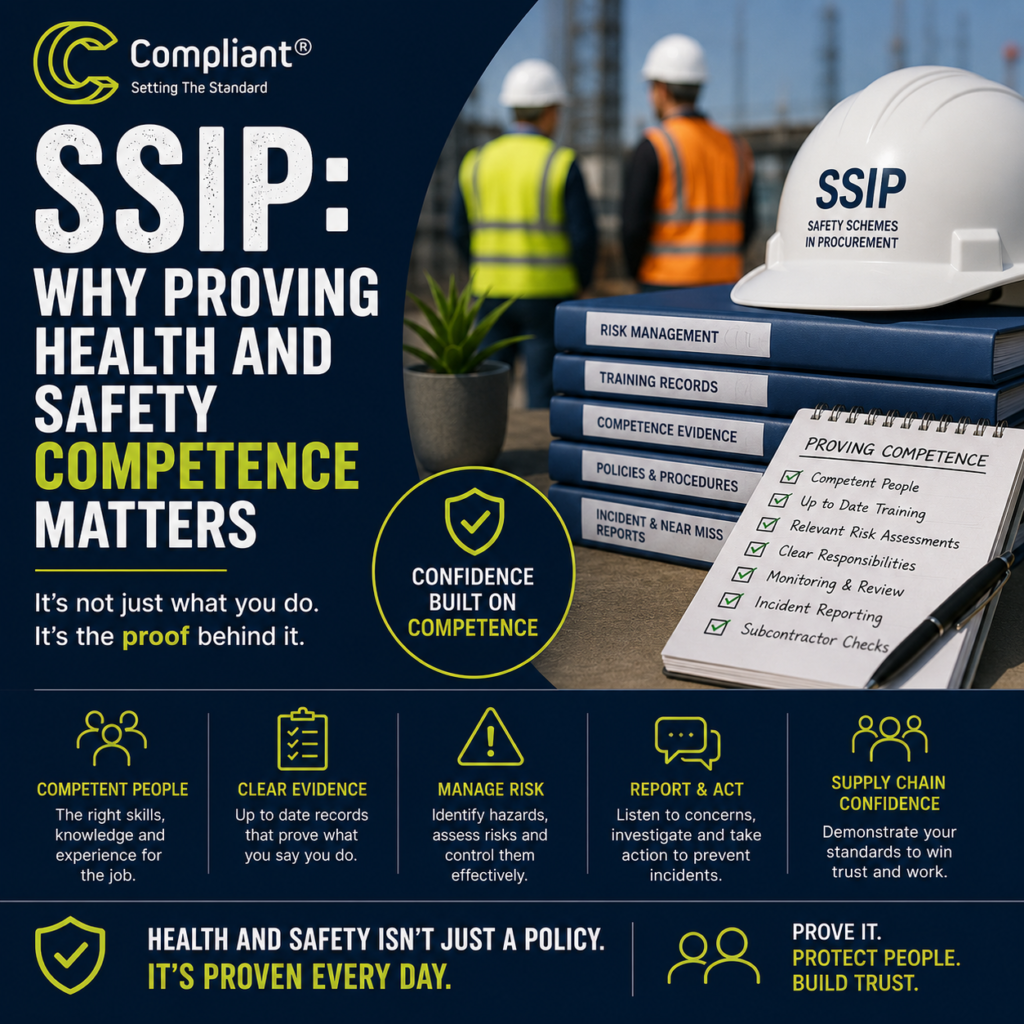
SSIP: Why Proving Health and Safety Competence Matters
A health and safety policy can say all the right things.
Your training records can be up to date.
Your risk assessments can be neatly stored.
Your employees may know exactly how to carry out their work safely.
But when a customer, main contractor or buyer asks you to prove your health and safety competence, can you?
That is where many businesses discover a problem.
It is not always that they are working unsafely.
Quite often, they are doing many of the right things. The problem is that their evidence is scattered across different folders, responsibilities are unclear, documents have not been reviewed or nobody can quickly show how health and safety is actually managed.
That can become more than an administrative headache.
It can affect opportunities to work with certain customers and contractors. It can slow down the approval process. It may raise questions about how well health and safety is managed across the organisation.
This is where SSIP, which stands for Safety Schemes in Procurement, becomes important.
SSIP helps create a recognised approach to assessing health and safety arrangements during the supplier selection process.
But there is a bigger lesson behind it.
Good health and safety management is not only about saying your business takes safety seriously.
You need to be able to show it.
And that evidence should reflect what really happens every day.
Saying You Work Safely Is Not Enough
Most businesses would say they care about health and safety.
Of course they do.
Nobody wants employees, contractors, visitors or members of the public to be harmed because of their work.
But customers need more than a promise.
Imagine you are choosing a contractor to carry out work on your site.
One business says:
“We take health and safety very seriously.”
Another can show how it identifies risks, trains its people, manages incidents, checks competence and keeps its arrangements under review.
Which gives you more confidence?
The second business is not simply making a claim.
It can support that claim with evidence.
This is one of the reasons health and safety assessment has become an important part of procurement.
Customers need confidence in the organisations they bring into their supply chain.
SSIP provides a way of helping businesses demonstrate that their health and safety arrangements have been assessed against recognised requirements.
What Is SSIP?
SSIP stands for Safety Schemes in Procurement.
It provides a framework through which recognised assessment schemes can assess a supplier’s health and safety arrangements.
For businesses, the important idea is straightforward.
Rather than every customer creating a completely different way of assessing basic health and safety competence, SSIP helps provide greater consistency.
This can make the process easier to understand.
However, businesses should not view SSIP as simply another badge or certificate to collect.
The value comes from what sits behind the assessment.
Your business needs to understand how it manages health and safety.
That means being able to demonstrate areas such as responsibilities, competence, risk management, communication and the way health and safety arrangements are reviewed.
The exact evidence required will depend on the business and the work being carried out.
A small office-based organisation will not have exactly the same risks as a construction contractor.
That is important.
Good health and safety management should reflect the work you actually do.
Competence Is More Than Having Training Certificates
Training is an important part of competence.
But a certificate alone does not tell the whole story.
Imagine two employees have completed the same training course.
One has used those skills every week for five years.
The other completed the course a year ago but has barely carried out the task since.
Their certificates might look almost identical.
Their practical experience could be very different.
Competence involves more than attending training.
People need suitable knowledge, skills and experience for the work they carry out.
They also need to understand the limits of what they can do.
Sometimes competence means knowing when to stop and ask for help.
Businesses therefore need to think carefully about how they know someone is able to carry out a task safely.
Training records are evidence.
Supervision can provide evidence.
Experience matters.
Observation may be useful.
The quality of completed work can tell you something.
The level of checking required should match the work and the risks involved.
The important point is being able to explain how your business reaches the decision that somebody is competent.
Evidence Should Match Reality
One of the biggest mistakes a business can make is creating documents purely because it thinks an assessor wants to see them.
A procedure is written.
Nobody uses it.
A risk assessment is created.
The employees carrying out the task have never seen it.
A training matrix looks impressive.
The information is six months out of date.
A health and safety policy says responsibilities are reviewed regularly.
Nobody can remember the last review.
On paper, the business may appear organised.
Look a little deeper and the gaps quickly become visible.
Good SSIP preparation should not be about creating a version of the business specifically for an assessment.
The evidence should reflect normal working practices.
If a procedure says something happens, it should happen.
If employees have responsibilities, they should understand them.
If a check is supposed to take place, there should be evidence that it does.
That is far more valuable than producing paperwork for paperwork’s sake.
Start With Clear Responsibilities
Who is responsible for health and safety in your business?
It sounds like a simple question.
The answer can become surprisingly unclear.
Perhaps one person maintains records.
A manager approves risk assessments.
Supervisors monitor work.
Employees report problems.
An outside adviser provides support.
Senior management makes decisions about resources.
All of these people may have a role.
The important thing is that responsibilities are understood.
If everybody assumes somebody else is responsible for checking training, training records can become outdated.
If nobody knows who should respond to a reported hazard, the problem can remain unresolved.
If managers believe health and safety belongs entirely to one designated employee, important decisions may not receive the leadership attention they need.
Clear responsibilities help prevent these gaps.
People should know what is expected from them.
Risk Assessments Need to Describe Today’s Work
Having risk assessments is important.
Having relevant risk assessments is more important.
Businesses change.
Equipment changes.
Employees change.
Workplaces change.
Customers introduce different requirements.
New tasks appear.
Working methods develop.
A risk assessment created several years ago may no longer describe what happens today.
This is why review matters.
Ask whether anything has changed since the assessment was created.
Have there been incidents or near misses?
Have employees raised concerns?
Has new equipment been introduced?
Is the work being carried out differently?
Are different people involved?
A risk assessment should help people understand and control risk.
It should not be an old document that remains untouched because somebody once signed it.
Your Employees Are Part of the Evidence
Health and safety is not something that exists only in management documents.
Employees are a major part of the system.
Do they understand the risks connected with their work?
Do they know how to report a problem?
Do they know what to do if something feels unsafe?
Have they received suitable information and training?
Do they know who to speak to?
Can they explain the important parts of their role?
This is why communication matters.
A business can have excellent written arrangements, but if the people carrying out the work do not understand them, something is missing.
Speak to employees.
Do not assume a signed training record means everything has been understood.
Ask questions.
Listen to what they say.
They may also identify risks and weaknesses that managers have not noticed.
Near Misses Matter
An accident happens and everyone pays attention.
A near miss happens and it can be tempting to carry on.
Nobody was hurt.
Nothing was damaged.
Problem avoided.
But was it?
A near miss can be valuable information.
It shows that something nearly went wrong.
The outcome happened to be harmless this time.
Next time may be different.
Strong health and safety management looks at these warning signs.
What happened?
Why?
Could it happen again?
Does something need changing?
Do employees know how to report near misses?
More importantly, do they feel comfortable doing so?
If people think reporting a near miss will result in blame, they may keep quiet.
That removes an opportunity for the business to learn.
Do Something With What People Report
Encouraging employees to report safety concerns is only useful if the business responds.
Imagine someone reports damaged equipment.
Nothing happens.
They report another problem a few weeks later.
Again, nothing changes.
How long before they stop reporting issues?
People need to see that concerns are taken seriously.
That does not mean every suggestion will result in immediate action.
Sometimes investigation may show that existing controls are suitable.
But communicate the outcome.
Let people know what was considered and what will happen next.
Closing that loop helps build trust.
It also provides evidence that the business is actively managing health and safety rather than simply collecting reports.
Keep Training Records Under Control
Training records can become difficult to manage as a business grows.
Ten employees become twenty.
New roles appear.
People move departments.
Certificates expire at different times.
Refresher training is required.
Temporary employees arrive.
Subcontractors are used.
A simple spreadsheet can suddenly become much more complicated.
Whatever system you use, it should answer basic questions.
What training does this role require?
Has the employee completed it?
When does anything need renewing?
Has the person’s role changed?
Is additional training required?
Who checks this information?
Do not wait until an assessment to discover that something expired months ago.
Regular checks make the process far easier.
They also help ensure employees have the knowledge they need today, which is the real reason the records exist.
Subcontractors Cannot Simply Be Forgotten
Many organisations rely on subcontractors.
That does not mean health and safety responsibility disappears when work is passed to somebody else.
Businesses need suitable ways to check the people and organisations carrying out work on their behalf.
What evidence is required?
Does the subcontractor understand your site rules?
Are they competent for the work?
Do they understand relevant risks?
How will their work be monitored where appropriate?
What happens if something goes wrong?
The level of control should suit the nature and risk of the work.
The key is not to assume that another business has everything covered.
Know what you need to check.
Then check it.
Keep Your Documents Current
One of the simplest ways businesses create problems for themselves is allowing documents to become outdated.
A policy still contains the name of someone who left two years ago.
An organisation chart no longer reflects the team.
Old contact details remain in an emergency plan.
A procedure refers to equipment that is no longer used.
Training records have not been updated.
None of these problems necessarily means the business is unsafe.
But together, they raise questions.
If the basic information is not current, what else might have been missed?
Set sensible review points.
Do not wait for an assessment to remind you.
And remember that review does not always mean rewriting the document.
Sometimes the review confirms that nothing needs changing.
Record that where appropriate and move on.
Do Not Create More Paperwork Than You Need
Businesses can become nervous when preparing for an assessment.
That nervousness often creates paperwork.
Someone thinks:
“We might be asked about this.”
So they create a form.
Then another checklist.
Then another procedure.
Soon the health and safety system becomes difficult for employees to use.
More documents do not automatically mean better health and safety.
The goal should be enough information to manage risk properly and demonstrate what the business does.
Simple processes are often easier to follow consistently.
Before creating another document, ask:
Why do we need this?
Who will use it?
What problem does it solve?
Does the information already exist somewhere else?
Will we actually keep it updated?
If you cannot answer those questions, think carefully before adding it.
Health and Safety Performance Should Be Reviewed
How does your business know whether its health and safety arrangements are working?
Looking only at accident numbers may not tell you enough.
No accidents is clearly positive.
But remember the earlier point: no accidents does not automatically mean no risks.
Consider other information.
Near misses.
Reported hazards.
Training completion.
Inspection findings.
Repeated issues.
Actions from meetings.
Employee feedback.
Internal reviews.
The information you use should suit the organisation.
The purpose is to spot patterns.
If the same problem keeps appearing, investigate.
If reporting suddenly stops, ask why.
If actions remain open for months, understand what is causing the delay.
Useful information should lead to useful questions.
Leadership Needs to Be Visible
Health and safety cannot be something senior leaders only discuss when an incident occurs.
Their decisions affect safety every day.
Budgets.
Staffing.
Equipment.
Deadlines.
Training.
Maintenance.
Workload.
All can influence how safely people work.
If managers say safety is important but employees are regularly pressured to take shortcuts, the message is clear.
People watch actions more than policies.
Strong leadership means making sensible health and safety decisions even when they are inconvenient.
It also means listening to employees and making resources available when improvements are needed.
The Benefits of an ISO Consultant’s Support
Businesses preparing for SSIP assessment can sometimes struggle to see their own gaps.
That is understandable.
When you work with the same processes every day, they become normal.
A document may have been used for years without anyone noticing that it no longer reflects what actually happens.
This is where the benefits of an ISO consultant’s support can be valuable.
An experienced consultant can provide an outside view.
They can help the business understand what evidence may be needed and, more importantly, why that evidence matters.
They can ask practical questions.
How do you know this employee is competent?
When was this risk assessment reviewed?
Who is responsible for this action?
How are subcontractors checked?
What happens after a near miss?
How do employees report concerns?
How do you know your health and safety processes are working?
These questions can uncover gaps before an assessment.
But the goal should not simply be passing.
A good consultant should help the business create clearer, more manageable processes that employees and managers understand.
That creates value beyond the assessment itself.
SSIP Should Not Become an Annual Panic
A common problem with any external assessment is the last-minute rush.
Someone realises renewal is approaching.
Suddenly documents are being reviewed.
Training records are checked.
Risk assessments are updated.
Evidence is chased.
Managers are asked to sign things.
Everyone becomes stressed.
Then the assessment is completed and the files are ignored until next year.
That approach misses the point.
Health and safety competence needs to exist throughout the year.
The easiest way to prepare for an assessment is to keep the system working every day.
Update records when things happen.
Review risks when work changes.
Record training when it is completed.
Close actions.
Investigate incidents.
Listen to employees.
Then assessment becomes a chance to demonstrate what you already do.
Not a race to create evidence of what should have been happening.
Internal Checks Can Find Problems Early
You do not need to wait for somebody outside the business to tell you where the gaps are.
Carry out your own checks.
Choose an area.
Look at the records.
Then compare them with reality.
If a procedure says equipment is inspected, check whether those inspections happen.
If a training matrix says an employee is competent, understand the evidence behind that decision.
If a risk assessment describes a task, watch the task.
Speak to employees.
Do they understand what is expected?
These simple checks can uncover problems while they are still easy to fix.
That is much better than discovering them during an assessment.
And far better than discovering them after an incident.
Proving Competence Builds Confidence
Being able to demonstrate health and safety competence matters for more than assessment.
It gives customers confidence.
It gives contractors confidence.
It gives managers confidence.
And importantly, it gives employees confidence that health and safety is being taken seriously.
Good evidence shows that processes are not based on assumptions.
The business knows who is trained.
It knows what risks exist.
It knows who is responsible.
It knows how problems are reported.
It knows what happens when something changes.
That creates a stronger organisation.
Start With One Role
You do not need to review your entire health and safety system today.
Start with one role.
Choose someone carrying out work that has health and safety risks.
Then ask:
What knowledge do they need?
What training do they need?
What experience is important?
How do we know they are competent?
What evidence can we show?
Do they understand the risks?
Do they know what to do if something goes wrong?
Are the records current?
Then speak to the person.
Compare the paperwork with reality.
If the two match, you have useful evidence that the system is working.
If they do not, you have found an opportunity to improve.
Health and Safety Competence Should Be Visible Every Day
SSIP can help businesses demonstrate that their health and safety arrangements have been assessed.
But the real value sits behind that recognition.
It is in the supervisor who notices a problem before somebody gets hurt.
The employee who feels comfortable reporting a near miss.
The manager who checks that training remains current.
The business that reviews a risk assessment because the work has changed.
The contractor who is checked before arriving on site.
The action that is completed rather than forgotten.
These are the everyday behaviours that demonstrate health and safety competence.
Certificates and assessment evidence matter.
But they should tell the story of what is already happening inside the business.
So ask yourself a simple question:
If a customer asked us tomorrow to prove how we manage health and safety, could we show them clearly and confidently?
If the answer is yes, great.
If the answer involves searching through old folders, chasing people for records and hoping everything is current, that tells you where to begin.
Do not wait for the next assessment.
Choose one area and check it now.
Because proving health and safety competence should never be about creating the right answer for an assessor.
It should be about being able to show that the right things happen when nobody is assessing you at all.