Skip to main content
Skip to footer
Skip to main content
Skip to footer

Why Businesses Are Moving Towards Integrated ISO Systems
Why Businesses Are Moving Towards Integrated ISO Systems
Running one ISO management system can take time.
Running two, three or even four separately can create a completely different problem.
One person manages ISO 9001.
Someone else looks after ISO 14001.
Health and safety sits with another manager.
Information security has its own processes, meetings and records.
Before long, the business can have several management systems trying to achieve different things while using many of the same people.
There are separate audits.
Separate meetings.
Separate objectives.
Separate documents.
Separate reviews.
And sometimes, different versions of the same process.
The result?
More work.
More confusion.
More opportunities for something to be missed.
This is one of the reasons businesses are increasingly looking towards Integrated Management Systems.
Instead of treating each ISO standard as a separate project, an Integrated Management System brings suitable parts of different standards together into one organised approach.
Quality can work alongside environmental management.
Health and safety can sit within the same wider system.
Information security can be connected where appropriate.
The standards do not lose their individual purpose.
But the business stops managing them as separate islands.
And for organisations dealing with several ISO standards, that can make a significant difference.
When Separate Systems Start Creating More Work Than Value
Imagine your organisation has ISO 9001 and ISO 14001.
You have a quality management system.
You also have an environmental management system.
Both need leadership involvement.
Both require objectives.
Both involve risks and opportunities.
Both need internal audits.
Both need management review.
Both require control over certain information.
Both need improvement.
Yet the organisation treats them as completely separate systems.
That might mean two sets of meetings.
Two audit programmes.
Different ways of recording actions.
Different document structures.
Different people asking senior management similar questions at different times.
Now add ISO 45001.
Then perhaps ISO 27001.
The amount of duplicated work can grow very quickly.
Employees may begin to see ISO as something that creates paperwork rather than something that helps the organisation.
That is a problem.
A management system should help you manage the business.
It should not become another business that you have to manage.
What Is an Integrated Management System?
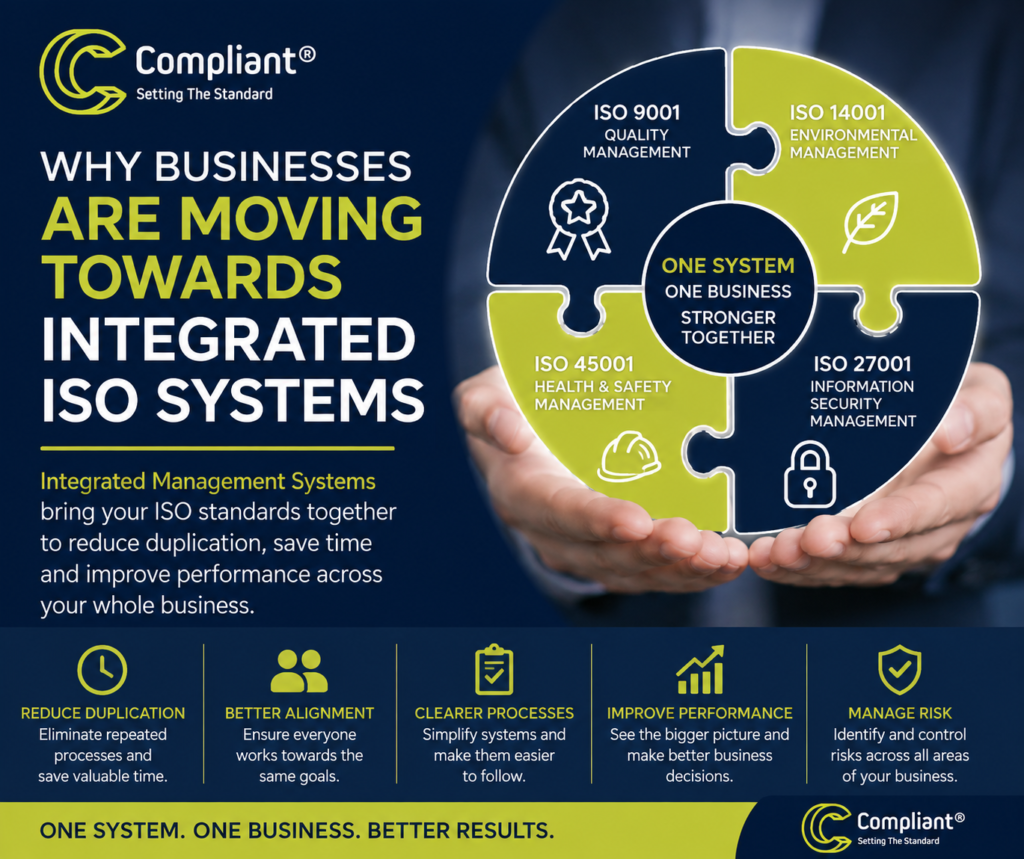
An Integrated Management System, often called an IMS, brings together suitable parts of two or more management systems.
For example, an organisation might integrate:
- ISO 9001 for quality management
- ISO 14001 for environmental management
- ISO 45001 for occupational health and safety
- ISO 27001 for information security management
This does not mean pretending all the standards are identical.
They are not.
Each has its own purpose and requirements.
ISO 9001 focuses on quality.
ISO 14001 focuses on environmental management.
ISO 45001 focuses on occupational health and safety.
ISO 27001 focuses on information security.
But there are areas where these systems can work together.
Leadership is one example.
Internal audits are another.
Management reviews can often be coordinated.
Document control can be managed consistently.
Improvement processes can be connected.
Objectives can be considered as part of the wider direction of the organisation.
Instead of asking, “How do we run four ISO systems?”
The better question may be:
“How can we run one business management system that addresses the standards we need?”
That change in thinking is important.
Your Business Is Already Integrated
Think about how your organisation actually works.
When a manager makes a decision, does that decision only affect quality?
Probably not.
Imagine your business decides to change a supplier.
That decision could affect the quality of your product or service.
It could affect environmental performance.
It might create new health and safety risks.
It could even affect information security if the supplier has access to your systems or data.
One business decision can touch several areas at once.
So why would you always manage those areas separately?
Your employees do not work inside individual ISO standards.
They work inside your business.
Your processes cross departments.
Your risks can overlap.
Your objectives can affect each other.
Integrated Management Systems recognise this reality.
They help organisations manage connected issues in a connected way.
The Problem With Duplicate Processes
Duplication can hide in plain sight.
Perhaps each management system has its own process for controlling documents.
Why?
Maybe there are separate corrective action forms for quality, environment and health and safety.
Why?
Perhaps each system has its own internal audit calendar, even though the same department is being audited several times.
Why?
Sometimes there is a good reason for keeping activities separate.
Often there isn’t.
The processes simply grew that way because each standard was introduced at a different time.
ISO 9001 came first.
Then ISO 14001 was added.
Years later, ISO 45001 arrived.
Each new standard was built alongside the existing system rather than into it.
Eventually, the organisation ends up maintaining several structures.
An Integrated Management System gives you the chance to ask:
Do we really need to do this more than once?
That question alone can uncover a great deal of wasted effort.
Integration Can Make ISO Easier for Employees
Employees should not need to become ISO experts simply to do their jobs properly.
Yet separate systems can create unnecessary confusion.
Imagine an employee needs to report a problem.
Is it a quality issue?
An environmental issue?
A health and safety issue?
What if it affects all three?
Which form do they use?
Who receives it?
Where is it recorded?
A well-designed Integrated Management System can make this simpler.
There may be one clear way to report issues, with the organisation then deciding which areas are affected.
The employee does not need to worry about which ISO standard owns the problem.
They simply need to know what to do.
That is a much more practical approach.
Good management systems should make the right action easier.
They should not force employees to understand the structure behind every requirement.
One Business, One Direction
Leadership is another strong reason for integration.
Senior managers are responsible for running the whole organisation.
They are not running one business for quality, another for environmental performance and a third for health and safety.
They need to see the wider picture.
An Integrated Management System can help leadership look at performance in a more joined-up way.
For example, a decision to increase production may look positive from a sales point of view.
But what does it mean for quality?
Can the business maintain standards?
What does it mean for employees?
Will workloads increase?
Does it create new safety risks?
What happens to waste or energy use?
Are new suppliers required?
Could information security be affected by new systems?
Looking at these questions together can support better decisions.
Integration can help move ISO away from individual departments and closer to the way senior leaders actually manage the business.
Risk Does Not Respect Department Boundaries
Risks rarely arrive neatly labelled.
A supplier problem could become a quality issue.
It might also cause delays.
Those delays could increase pressure on employees.
Rushed work could create safety problems.
The business might switch suppliers quickly without completing the usual checks.
That could introduce information security or environmental concerns.
One event can create a chain of problems.
When risks are managed separately, these links can be missed.
Integrated Management Systems can encourage organisations to consider the wider effect of risk.
Different areas still need specialist attention where necessary.
But they can be considered as part of one business picture.
That helps managers understand how decisions in one area can affect another.
Internal Audits Can Become More Useful
Internal audits are an important part of ISO management systems.
But poorly planned audits can become repetitive.
A department may be visited several times during the year.
One auditor asks about quality.
Another comes later to discuss environmental management.
Then somebody else arrives to review health and safety.
Some of the questions overlap.
The same manager has to explain the same processes repeatedly.
Employees can develop audit fatigue.
They start seeing audits as interruptions rather than opportunities to improve.
Integration can allow organisations to take a more coordinated approach.
Where appropriate, an internal audit can look at a process across several relevant areas.
For example, a purchasing process might be reviewed for:
- Supplier quality
- Environmental considerations
- Health and safety requirements
- Information security concerns
That can provide a more complete picture of how well the process is working.
It may also make the audit more useful to the people running the business.
Management Reviews Can Be More Meaningful
Management review should be useful.
It should give senior leaders information that helps them understand performance and make decisions.
But imagine an organisation with several completely separate systems.
Quality has a management review.
Environmental management has another.
Health and safety has another.
Information security has another.
Some of the same senior managers attend every meeting.
Many of the discussions overlap.
The business ends up reviewing itself in pieces.
An Integrated Management System can allow relevant areas to be considered together.
This does not mean rushing through everything in one huge meeting.
The organisation still needs to give each subject the attention it requires.
But information can be presented in a way that helps leaders understand the connections.
Instead of simply reviewing individual standards, leadership can review the performance of the organisation.
That is a much stronger use of management time.
Integration Can Improve Objectives
Business objectives often affect several areas at once.
Imagine an organisation sets an objective to reduce delivery times.
That sounds like a quality or customer service objective.
But how will it be achieved?
Will drivers be under more pressure?
Could that create health and safety concerns?
Will more vehicles be needed?
What could that mean for environmental performance?
Will new technology be introduced to track deliveries?
Does that create information security considerations?
An Integrated Management System encourages businesses to think beyond the first result they want.
That can lead to better objectives.
It can also prevent one improvement from accidentally creating a problem somewhere else.
Less Paperwork Does Not Mean Less Control
One of the common reasons businesses become interested in integration is the hope of reducing paperwork.
That can happen.
But reducing paperwork should not mean removing useful controls.
The goal is to remove unnecessary duplication.
There is a big difference.
If three systems require you to control important documented information, you may not need three separate ways of doing it.
If several standards require internal audits, you may be able to create one coordinated audit programme.
If improvement actions are currently stored in several places, perhaps they can be managed through one clear process.
The aim is simplicity.
Not shortcuts.
A good Integrated Management System should make responsibilities clearer while still giving each standard the attention it needs.
Integration Does Not Mean Forcing Everything Together
This is an important warning.
Not everything should be integrated simply because it can be.
Some processes need to remain specific.
An information security incident may require different knowledge and actions from a workplace safety incident.
Environmental risks may need specialist controls.
Certain legal requirements may apply to one area but not another.
The goal is not to squeeze every requirement into one generic process.
That can create a system so broad that it becomes useless.
Good integration means combining areas where doing so adds value.
And keeping things separate where there is a good reason.
Think of it like organising a toolbox.
You want everything arranged clearly.
You do not melt all the tools together to make one giant tool.
Integrated Management Systems Can Support Growth
A business with one ISO standard may not see integration as an immediate concern.
But think ahead.
Perhaps you currently hold ISO 9001.
Customers begin asking about ISO 14001.
Later, a major contract requires stronger health and safety management.
Then information security becomes important.
If every new standard is built as a completely separate system, the amount of management work can keep growing.
A more integrated approach can make future growth easier to manage.
The organisation already has a structure.
Leadership responsibilities are understood.
Audit processes exist.
Document controls are established.
Improvement is already part of the system.
A new standard will still bring new requirements.
But you may not need to rebuild everything from the beginning.
That can make adding further standards much less disruptive.
Integration Can Help Break Down Silos
Departments naturally focus on their own responsibilities.
The quality team thinks about quality.
The environmental team focuses on environmental performance.
Health and safety professionals focus on protecting people.
IT looks at systems and information.
There is nothing wrong with specialist knowledge.
Businesses need it.
Problems begin when those teams stop talking to each other.
A change that solves one department’s problem can create difficulties for another.
An Integrated Management System can encourage greater communication between different areas.
People begin to see where their responsibilities overlap.
Risks can be discussed together.
Changes can be reviewed from several viewpoints.
That can create better decisions.
And sometimes the greatest value of integration is not the paperwork it removes.
It is the conversations it creates.
Where Can an ISO Consultant Help?
Moving from several separate systems to an Integrated Management System can feel difficult.
Especially if those systems have existed independently for years.
Different departments may have their own documents.
Different managers may have their own ways of working.
People may be protective of processes they created.
Nobody wants to remove something important by mistake.
This is where the benefits of an ISO consultant’s support for Integrated Management Systems can become particularly useful.
An experienced ISO consultant can help you understand where your existing systems overlap.
They can help identify duplication.
They can also help you see where requirements genuinely need to remain separate.
This outside view can be valuable.
When you work with the same processes every day, unnecessary complexity can start to feel normal.
Sometimes you need somebody to ask:
“Why are you doing this twice?”
The answer might be:
“We’ve always done it that way.”
That is usually a good reason to look more closely.
An ISO Consultant Can Help Protect What Already Works
Integration should not mean tearing everything apart.
Your existing management systems may contain many strong processes.
Employees may understand them.
They may have been improved over years.
Throwing all of that away would make little sense.
Good ISO consultant support should start by understanding what already works.
Which processes can remain?
Which can be combined?
Where is there duplication?
Where are the gaps?
What needs to stay separate?
This approach can make integration much more manageable.
Instead of rebuilding your management systems from nothing, you improve the way they connect.
Integration Needs People, Not Just Documents
It is possible to create an Integrated Management System on paper while the business continues working exactly as it did before.
Quality still sits in one corner.
Environmental management sits somewhere else.
Health and safety has its own world.
Information security remains an IT issue.
The documents might say “integrated”.
The organisation isn’t.
Real integration requires people to work differently.
Responsibilities need to be understood.
Departments need to communicate.
Leadership needs to consider the wider picture.
Employees need clear processes.
An ISO consultant can help with the structure, but your organisation needs to make integration real.
That is why employee and leadership involvement is so important.
Could Integration Save Your Managers Time?
Think about the managers involved in your ISO systems.
How many meetings do they attend?
How many audits?
How many reports do they review?
How many action lists are they responsible for?
How many times do they provide the same information to different people?
Now ask:
How much of that work genuinely needs to happen separately?
The answer will be different for every organisation.
But if your business operates several ISO management systems, it is a question worth asking.
Reducing unnecessary repetition gives managers more time to focus on improvement.
That is where ISO should add value.
Not in repeating the same administrative task four times.
Is Your Management System Helping You Run the Business?
This may be the most important question of all.
ISO management systems should not exist purely for assessment day.
They should help you understand risks.
They should help you improve.
They should support consistent ways of working.
They should provide useful information to leadership.
They should help employees understand what is expected.
If your systems have become so complicated that people work around them, something needs to change.
If managers only think about ISO when an audit is approaching, something needs to change.
If employees see the management system as paperwork rather than part of their work, something needs to change.
Integrated Management Systems provide an opportunity to simplify.
But more importantly, they provide an opportunity to reconnect ISO with the business itself.
Why Businesses Are Moving Towards Integrated ISO Systems
Businesses are under pressure from many directions.
Customers expect quality.
Environmental performance matters.
Employees need safe workplaces.
Information needs protecting.
Legal and other requirements need to be understood.
Risks need managing.
At the same time, businesses need to remain efficient.
Managing every responsibility through a separate system can make that harder than it needs to be.
That is why more organisations are looking at integration.
One organisation.
One leadership team.
One overall direction.
One connected approach to management.
The individual ISO standards still matter.
Their specific requirements still need to be met.
But they can work together.
When integration is done well, ISO becomes less about managing standards and more about managing the organisation.
And that is where the real value can begin.
A Useful Next Step
If your organisation currently manages two or more ISO standards, try a simple exercise.
Write down the main activities within each management system.
Include:
- Internal audits
- Management reviews
- Objectives
- Document control
- Corrective actions
- Training
- Risk management
- Performance monitoring
- Improvement activities
Then put the lists next to each other.
Look for repetition.
Are different teams completing similar tasks?
Are senior managers attending several meetings that cover related information?
Are employees using different processes to report similar problems?
Are there several action lists when one clear system could work better?
Do not immediately change anything.
First, understand where the duplication exists.
Then ask:
“Would bringing these areas together make the business easier to manage without weakening the controls we need?”
If the answer is yes, you may have found a good place to begin integration.
If you choose to use ISO consultant support for Integrated Management Systems, ask the consultant to help you simplify rather than simply combine documents. The goal should be a management system your employees understand, your leaders can use and your organisation can maintain.
Integration is not about having fewer standards.
It is about making those standards work better together.
Because your organisation does not operate as several separate businesses.
Your management system should not either.