Skip to main content
Skip to footer
Skip to main content
Skip to footer

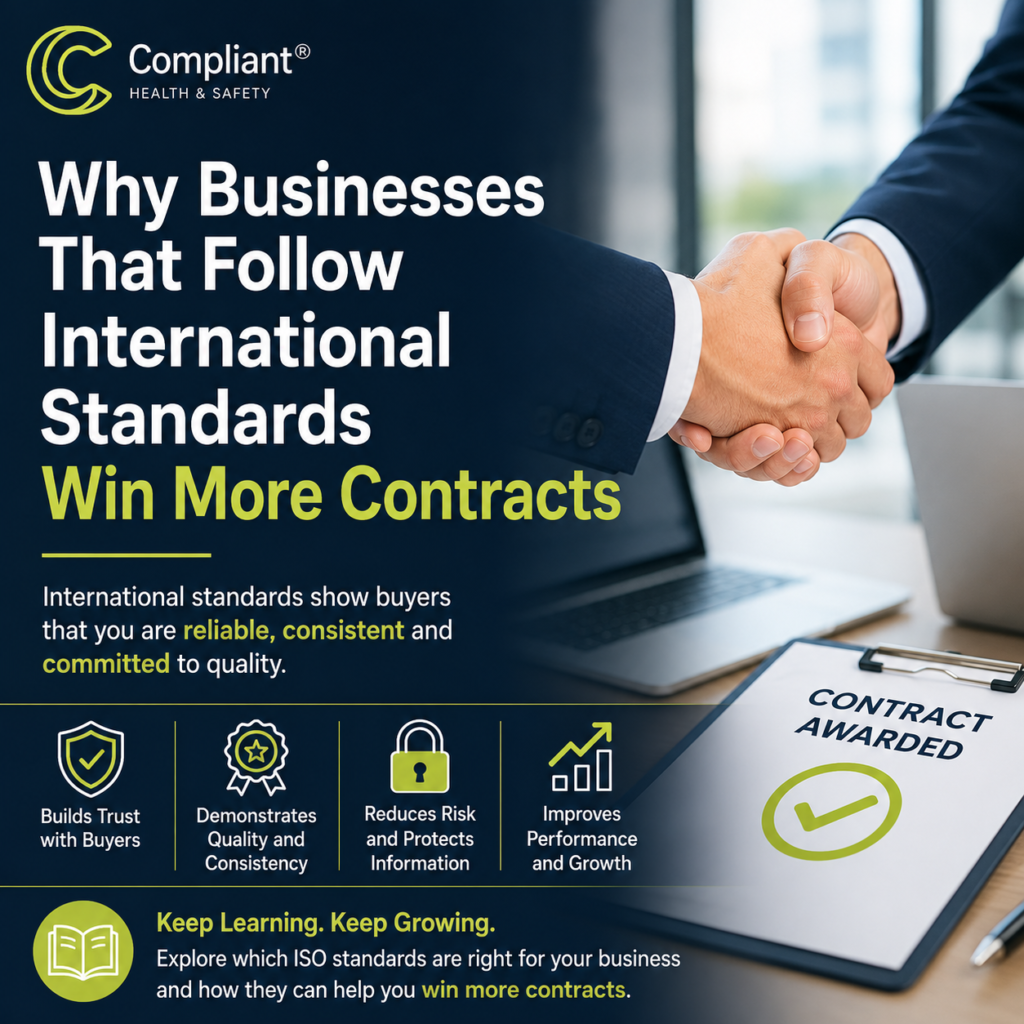
Why Businesses That Follow International Standards Win More Contracts
Why Businesses That Follow International Standards Win More Contracts
The Businesses Winning the Biggest Contracts Are Rarely the Cheapest
Imagine spending days preparing a tender.
Your team has worked hard. Your pricing is competitive. Your experience is strong. You know you can deliver a great service.
Then the results arrive.
Another business wins.
Again.
You start asking the same questions.
“Were they cheaper?”
“Did they know someone?”
“What are we missing?”
In many cases, the answer has nothing to do with price.
It comes down to trust.
Organisations today want suppliers who can prove they work to recognised standards. They want businesses that reduce risk, protect information, care about quality, and continually improve.
That is exactly what ISO standards help demonstrate.
Whether you work with local authorities, large private companies, housing associations, healthcare providers, manufacturers, or education providers, following internationally recognised standards can make a huge difference when you’re trying to win more contracts.
In this guide, we’ll explain why ISO certification matters, how buyers use it when choosing suppliers, and the benefits of an ISO consultant’s support when working towards certification.
Why Winning Contracts Has Become More Competitive
Businesses today have more competition than ever.
Technology allows companies to bid for work across the country and even internationally.
That gives buyers more choice.
But more choice also creates more risk.
How can a buyer know which supplier will deliver on time?
How do they know who takes quality seriously?
How do they know customer information will stay secure?
How do they know health and safety will be managed properly?
They cannot simply rely on promises.
They need evidence.
This is why procurement teams increasingly ask for recognised certifications during the tender process.
These certifications provide reassurance before any contract is awarded.
What Are International Standards?
International standards are agreed ways of managing different parts of a business.
They help organisations build reliable systems rather than relying on individual people.
Some of the most recognised standards include:
- ISO 9001 for Quality Management
- ISO 14001 for Environmental Management
- ISO 27001 for Information Security
- ISO 45001 for Occupational Health and Safety
Each standard focuses on a different area, but together they all encourage businesses to:
- Improve consistency
- Reduce mistakes
- Manage risk
- Keep improving
- Deliver better results for customers
Most importantly, they give customers confidence.
Why Buyers Trust ISO-Certified Businesses
Think about it from the customer’s point of view.
If you’re choosing between two suppliers with similar prices and experience, which would you choose?
One says:
“We’re committed to quality.”
The other says:
“We’re independently certified to ISO 9001.”
Which statement feels stronger?
Certification shows that an independent body has checked your systems.
It is not simply your opinion.
It is evidence.
That independent verification often gives procurement teams the confidence they need to move your application forward.
ISO Helps Reduce Risk
Every organisation wants fewer surprises.
Late deliveries.
Poor communication.
Security breaches.
Health and safety incidents.
Customer complaints.
These problems cost time and money.
ISO standards encourage businesses to identify risks before they become problems.
That proactive approach is exactly what customers are looking for.
When buyers see recognised standards in place, they know the supplier is already managing many of the risks that could affect the contract.
Tender Documents Increasingly Ask for ISO Certification
Many organisations no longer ask whether you have ISO certification.
They assume you do.
Tender questionnaires often include sections asking for:
- Current ISO certificates
- Management systems
- Risk management processes
- Internal audits
- Continual improvement activities
- Security controls
- Environmental commitments
Sometimes certification is mandatory.
Sometimes it earns valuable points during scoring.
Even when it is not essential, it often strengthens your application.
That can be the difference between reaching the next stage or being ruled out early.
ISO Gives Smaller Businesses a Competitive Edge
Many small businesses believe ISO is only for large organisations.
That simply isn’t true.
In fact, smaller businesses often benefit the most.
Certification helps level the playing field.
It allows a growing business to demonstrate professionalism that matches much larger competitors.
Customers see structured processes rather than company size.
They see commitment rather than assumptions.
That creates opportunities that may not have existed before.
ISO 9001 Shows You Take Quality Seriously
Quality matters in every industry.
Customers expect products and services that meet their expectations every time.
ISO 9001 helps businesses achieve this through consistent processes.
Instead of relying on memory or individual knowledge, work is carried out using agreed methods.
Problems are recorded.
Lessons are learned.
Processes improve.
Customers receive a more reliable service.
When buyers compare suppliers, this consistency becomes extremely valuable.
ISO 27001 Builds Confidence in Data Security
Cyber threats continue to grow.
Businesses now hold huge amounts of customer information.
Protecting that information has never been more important.
ISO 27001 helps organisations manage information security in a structured way.
It encourages businesses to:
- Understand information risks
- Protect sensitive data
- Control access
- Respond to incidents
- Improve security over time
For sectors such as finance, healthcare, legal services and technology, this reassurance can play a major role in winning contracts.
Even organisations outside these industries increasingly expect suppliers to demonstrate strong information security.
ISO 14001 Supports Responsible Business
Many customers want suppliers who care about their environmental impact.
This isn’t just about protecting the planet.
It is also about reducing waste, improving efficiency and planning for the future.
ISO 14001 provides a framework that helps businesses:
- Reduce waste
- Use resources wisely
- Meet environmental obligations
- Improve performance over time
Many public sector contracts now include environmental questions during procurement.
Being able to demonstrate recognised environmental management can strengthen your overall bid.
ISO 45001 Demonstrates Commitment to People
Health and safety affects every workplace.
Employees want to work safely.
Customers want contractors who manage risks responsibly.
ISO 45001 helps businesses create safer working environments through planning, training and continual improvement.
For industries such as construction, manufacturing and engineering, this standard is often highly valued during contract assessments.
It shows that safety is built into everyday operations rather than treated as an afterthought.
ISO Certification Supports Long-Term Growth
Winning one contract is important.
Winning contracts consistently is even better.
Businesses that follow international standards often discover benefits beyond procurement.
They may notice:
- Better customer satisfaction
- Fewer errors
- Improved communication
- Clearer responsibilities
- Stronger employee engagement
- More consistent performance
- Better decision making
These improvements create stronger businesses overall.
As your reputation grows, future opportunities often become easier to secure.
Certification Is Only Part of the Story
Holding a certificate is valuable.
Living by the principles behind it is even more valuable.
The best-performing organisations use ISO standards every day.
They regularly review performance.
They look for ways to improve.
They listen to customers.
They encourage staff involvement.
This culture of continual improvement helps businesses stay competitive in changing markets.
Customers notice that commitment.
So do procurement teams.
The Benefits of an ISO Consultant’s Support
Many businesses delay certification because they believe it will take too much time or become too complicated.
That concern is understandable.
Most organisations already have busy teams, demanding customers and daily operational pressures.
Adding another major project can feel overwhelming.
This is where the benefits of an ISO consultant’s support become clear.
An experienced ISO consultant understands both the requirements of the standard and the practical realities of running a business. Rather than creating unnecessary paperwork, they help build systems that fit the way your organisation already works.
A good consultant will begin by understanding your business. They look at your existing processes, identify what is already working well, and highlight any gaps that need attention. In many cases, businesses discover they are already meeting many of the requirements without realising it.
This makes the journey much more manageable.
Working with an ISO consultant can also help you avoid common mistakes.
These include:
- Creating documents that nobody uses.
- Making processes more complicated than they need to be.
- Missing important evidence before an audit.
- Spending time on tasks that add little value.
- Misunderstanding what an auditor is actually looking for.
Instead of guessing, you have expert guidance throughout the process.
Another major benefit is confidence.
Internal teams often feel uncertain before their certification audit. They worry about being asked difficult questions or overlooking something important.
An experienced consultant prepares your team for what to expect.
They carry out gap assessments.
They help develop policies and procedures.
They support internal audits.
They explain any findings clearly and provide practical solutions.
This structured approach helps businesses feel ready rather than rushed.
Perhaps the biggest advantage is that a consultant keeps the focus on improvement, not simply passing an audit.
The goal should never be to gain a certificate and forget about it.
The goal is to build a stronger business.
When your management systems genuinely improve the way you work, the benefits continue long after certification has been achieved.
That means happier customers, more engaged employees, fewer mistakes and greater confidence when bidding for future work.
An ISO consultant helps turn certification from a short-term project into a long-term business advantage.
Looking Beyond the Certificate
Winning more contracts is often the reason businesses begin their ISO journey.
It is a strong reason.
But it should not be the only one.
The organisations that gain the greatest value from ISO certification are those that use it as a framework for continual improvement.
They ask questions.
Could we work more efficiently?
Could we communicate better?
Could we reduce waste?
Could we improve customer satisfaction?
Could we manage risks more effectively?
Every improvement, no matter how small, makes the business stronger.
Over time, these small improvements add up to something much bigger.
Customers notice.
Employees notice.
Procurement teams notice.
That is why businesses that embrace international standards often continue to grow while others struggle to keep pace.
Conclusion
Competition for contracts is only becoming tougher.
Customers expect more than promises.
They want evidence that suppliers can deliver quality, protect information, manage risks and continually improve.
ISO standards provide that evidence.
They help businesses build trust, strengthen their reputation and create the confidence buyers need when awarding work.
While certification alone will not guarantee success, it gives organisations a clear advantage in competitive markets. Combined with a genuine commitment to improvement, it can help businesses win more contracts, retain existing customers and build lasting relationships.
For organisations beginning their certification journey, the benefits of an ISO consultant’s support can make the process simpler, more efficient and far more valuable. With expert guidance, businesses can avoid common pitfalls, build systems that work in practice and gain far more than a certificate on the wall.
Continue Learning
Winning contracts starts long before a tender is published.
Take time to review your current processes, identify where improvements can be made and understand which ISO standards are most relevant to your business.
The more prepared your organisation is, the more confidence you will inspire in customers, partners and procurement teams. That confidence could be the factor that helps you secure your next opportunity.