Skip to main content
Skip to footer
Skip to main content
Skip to footer

Why Warm Homes Local Grants Demand More Than Good Intentions
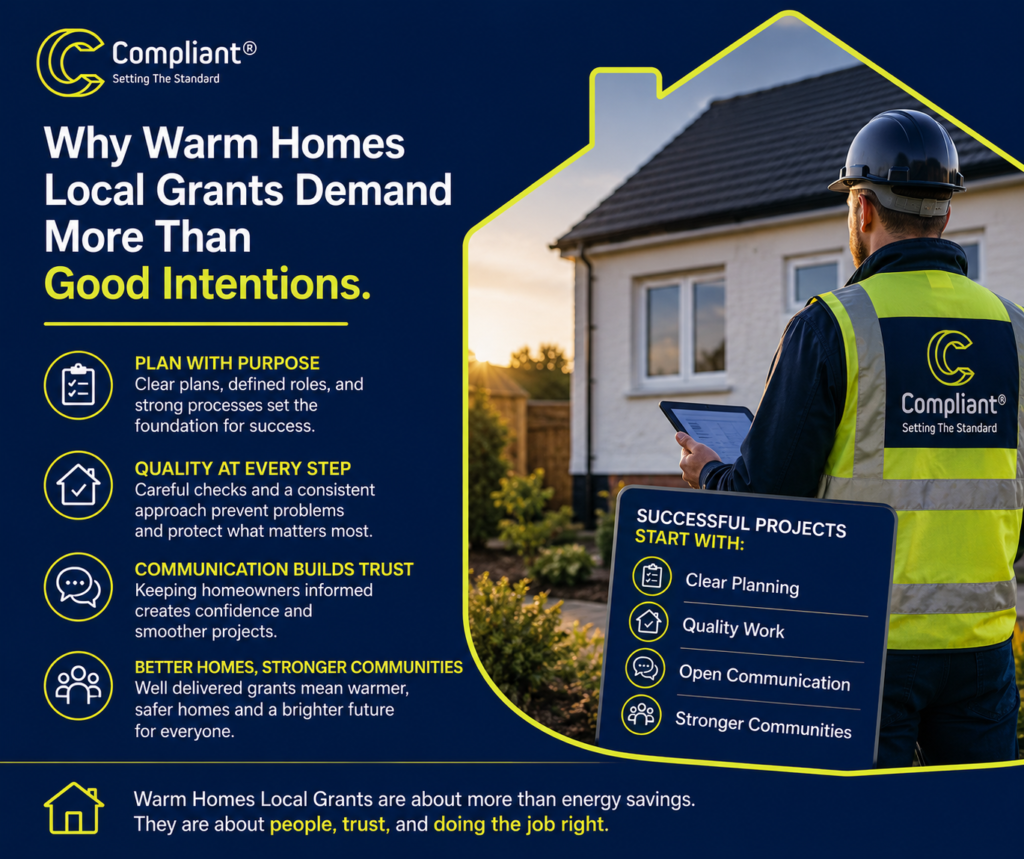

Many local councils have one goal. They want to make homes warmer, safer and cheaper to run. The funding is there. The demand is there. Yet many projects still slow down, fail checks or miss deadlines.
Why?
Because delivering work through Warm Homes Local Grants is not as simple as installing new insulation or replacing heating systems. Every stage must meet strict standards. Every decision matters. One mistake can lead to delays, failed audits or funding problems.
That pressure falls on everyone involved.
Local authorities want projects completed on time. Contractors want to keep working without costly rework. Housing providers need confidence that every home meets the right standards. Residents simply want warmer homes without months of disruption.
This is where many projects begin to struggle.
Understanding PAS 2030, meeting MCS requirements and keeping every part of a project compliant can feel overwhelming, especially when several organisations are working together.
The good news is that it does not have to be this way.
With the right planning and the right support, compliance becomes part of the process rather than a problem waiting to happen.
Why Warm Homes Local Grants Demand More Than Good Intentions
The Warm Homes Local Grants programme gives local authorities the chance to improve thousands of homes while helping families reduce energy bills.
That sounds simple.
In reality, every project carries responsibility.
Public money must be spent correctly.
Homes must receive the right improvements.
Evidence must be collected.
Installations must meet recognised standards.
Everything must stand up to inspection.
Missing one piece of information or taking a shortcut can have a knock-on effect across an entire project. A single issue may delay payments, create extra site visits or require expensive corrective work.
Nobody wants that.
The aim is always the same.
Deliver quality improvements that genuinely help people live in warmer, healthier homes.
To do that consistently, everyone involved needs a clear understanding of the standards that sit behind the funding.
What Is PAS 2030 and Why Does It Matter?
If you are delivering energy efficiency improvements, you have probably heard of PAS 2030.
But understanding why it matters is just as important as knowing what it is.
PAS 2030 sets the installation requirements for energy efficiency measures in existing homes.
It provides a clear framework for installers.
It helps make sure work is completed safely.
It supports consistent quality.
Most importantly, it protects the people living in the homes.
Without clear standards, every contractor could work differently.
Quality would vary.
Residents could receive poor workmanship.
Funding bodies would struggle to measure success.
Instead, PAS 2030 creates one clear benchmark.
Whether the work involves loft insulation, external wall insulation, heating upgrades or ventilation improvements, the same expectation applies.
The work must be completed properly.
That consistency builds confidence for local authorities, housing providers, contractors and residents alike.
Where MCS Fits Into the Picture
Many renewable technologies installed through government-backed schemes also require MCS certification.
This includes technologies such as heat pumps and solar panels.
While PAS 2030 focuses on installation standards for energy efficiency measures, MCS helps demonstrate that renewable technologies and installers meet recognised quality standards.
The two often work alongside each other.
That relationship is important.
When projects include renewable technologies, understanding both standards helps reduce confusion and keeps installations moving smoothly.
Ignoring one can affect the success of the whole project.
Compliance is rarely about one document.
It is about understanding how different standards connect.
Why Compliance Becomes Difficult
On paper, standards look straightforward.
Real projects are different.
Multiple contractors may be working across dozens or even hundreds of properties.
Different residents have different needs.
Unexpected problems appear once work begins.
Survey information changes.
Materials become unavailable.
Installation dates move.
Every small change creates more paperwork.
Every decision must still meet the required standards.
This is where many organisations start to feel pressure.
Compliance stops being a simple checklist.
Instead, it becomes a moving target that requires constant attention.
The larger the project becomes, the harder it is to keep everything aligned.
Without clear oversight, small issues quickly become bigger ones.
The Hidden Cost of Getting It Wrong
Many people focus on the visible costs.
Extra labour.
Replacement materials.
Delayed programmes.
Those are only part of the picture.
There are hidden costs too.
Failed audits.
Damaged reputations.
Lost confidence from funding providers.
More administration.
Extra inspections.
Complaints from residents.
Each one adds pressure.
Each one takes time away from delivering improvements.
For organisations managing public funding, those hidden costs often become more expensive than fixing the original mistake.
That is why getting compliance right from the beginning matters so much.
Why Every Stakeholder Feels the Pressure
Warm Homes Local Grants involve more than one organisation.
Local authorities oversee funding.
Housing providers coordinate programmes.
Contractors complete installations.
Retrofit professionals manage compliance.
Residents live with the results.
Each group has different responsibilities.
Yet one mistake affects everyone.
If documentation is incomplete, payments may be delayed.
If installations fail inspection, contractors return to site.
If residents lose confidence, complaints increase.
If funding targets are missed, future opportunities may be affected.
Success depends on every part of the chain working together.
The Benefits of a PAS Consultant’s Support for Warm Homes Local Grants
One of the biggest challenges is knowing whether every requirement has been fully understood.
Standards change.
Guidance develops.
Projects evolve.
Keeping up with everything while managing day-to-day delivery is difficult.
This is where the benefits of a PAS consultant’s support for Warm Homes Local Grants become clear.
A PAS consultant provides an independent view of compliance throughout the project.
Rather than waiting until the end to identify problems, they help spot issues before they become expensive.
That early support can save significant time.
It also reduces stress across the whole delivery team.
Better Planning From Day One
Strong projects begin long before the first installer arrives.
Planning matters.
Understanding which standards apply matters.
Knowing how evidence should be collected matters.
A PAS consultant helps build those foundations.
Instead of reacting to problems later, teams can prepare for them in advance.
That creates smoother project delivery.
Everyone understands their responsibilities.
Documentation becomes easier to manage.
The entire process feels more organised.
Helping Teams Stay Aligned
Large retrofit programmes involve many moving parts.
Surveyors.
Designers.
Installers.
Quality teams.
Project managers.
Everyone needs access to the same information.
If one person works from outdated guidance, mistakes happen.
PAS consultants help maintain consistency.
They provide clarity when questions arise.
They help ensure every team is working towards the same objective.
That consistency reduces confusion.
It also improves confidence throughout the project.
Supporting Quality Without Slowing Progress
Some people worry that compliance slows projects down.
It should not.
When compliance is built into daily work, it actually improves efficiency.
Problems are identified earlier.
Evidence is gathered correctly the first time.
Site visits become more productive.
Audits become less stressful.
Instead of stopping work to solve problems, teams keep moving forward.
Quality becomes part of normal operations rather than an extra task at the end.
Reducing Risk for Local Authorities
Local authorities carry significant responsibility.
They manage public funding.
They answer to stakeholders.
They report on project outcomes.
Every decision is closely examined.
Having expert compliance support reduces uncertainty.
It provides confidence that installations meet recognised standards.
It supports accurate reporting.
It strengthens project governance.
Most importantly, it helps protect public investment.
Building Trust With Residents
Residents rarely ask about standards.
They ask whether their home will be warmer.
Whether the work will last.
Whether they can trust the people entering their home.
Good compliance supports all of those concerns.
High-quality installations create better outcomes.
Clear documentation improves transparency.
Consistent delivery builds confidence.
When residents trust the process, projects run more smoothly.
Communication becomes easier.
Satisfaction improves.
That trust is valuable.
Future-Proofing Retrofit Projects
Energy efficiency continues to grow in importance.
Funding programmes will evolve.
Standards will continue developing.
Organisations that build strong compliance processes today will be better prepared for future opportunities.
Instead of starting again every time guidance changes, they already have systems in place.
Knowledge grows.
Experience increases.
Projects become easier to manage.
That long-term approach creates lasting value.
Compliance Is About More Than Passing Audits
Many people think compliance exists simply to satisfy inspectors.
That misses the bigger picture.
Compliance protects residents.
It supports quality workmanship.
It improves consistency.
It ensures public money delivers genuine improvements.
It creates confidence across the entire supply chain.
When everyone understands that purpose, standards stop feeling like obstacles.
They become tools that help deliver better outcomes.
Making PAS 2030 and MCS Work Together
Projects involving PAS 2030 and MCS often achieve the best results when they are viewed as connected rather than separate requirements.
Both focus on quality.
Both protect residents.
Both improve confidence.
Understanding how they fit together helps organisations avoid unnecessary delays.
It also reduces duplicated effort.
That joined-up thinking supports better project delivery from beginning to end.
Strong Projects Start With Strong Processes
Every successful retrofit programme shares one thing.
Clear processes.
Teams know what is expected.
Documentation is organised.
Evidence is collected correctly.
Questions are answered early.
Problems are addressed before they grow.
That approach creates confidence.
Not just during audits.
Every single day.
The Bigger Picture Behind Warm Homes Local Grants
The purpose of Warm Homes Local Grants goes far beyond compliance.
It is about helping people.
Families living in colder homes.
Older residents struggling with heating costs.
Communities facing rising energy bills.
Every successful installation has a real impact on someone’s daily life.
That is why quality matters.
Getting compliance right means more people receive the improvements they were promised.
Homes become healthier.
Energy bills become more manageable.
Communities become stronger.
Standards support those outcomes.
They are not simply paperwork.
They are part of delivering lasting change.
Final Thoughts
Delivering successful projects through Warm Homes Local Grants requires more than good intentions. It requires careful planning, consistent quality and a clear understanding of standards like PAS 2030 and MCS.
For many organisations, the challenge is not recognising the importance of compliance. It is finding the time, knowledge and confidence to manage it effectively across complex projects.
That is why understanding the benefits of a PAS consultant’s support for Warm Homes Local Grants is so valuable. Expert guidance helps reduce uncertainty, improve consistency and support better outcomes for everyone involved, from local authorities and contractors to housing providers and, most importantly, residents.
The strongest retrofit projects are rarely the ones that move the fastest. They are the ones built on good planning, clear communication and quality at every stage.
The better we understand the standards today, the easier it becomes to deliver warmer, safer and more energy-efficient homes tomorrow.
Continue Learning
If you’re involved in planning or delivering retrofit projects, take time to deepen your understanding of PAS 2030, MCS, and the requirements behind Warm Homes Local Grants. Staying informed about evolving standards, guidance and best practice will help you make better decisions, reduce project risk and deliver stronger outcomes for every home you improve.