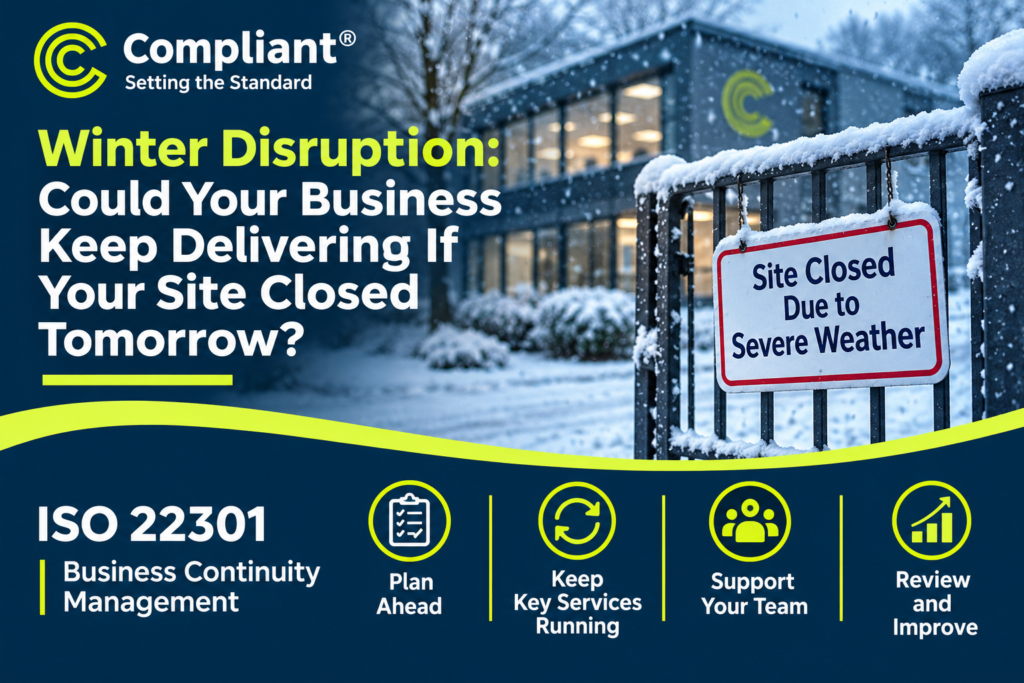
Winter Disruption: Could Your Business Keep Delivering If Your Site Closed Tomorrow?
 Imagine arriving at work on a cold Monday morning.
The weather forecast warned of heavy snow overnight, but you assumed it would be business as usual.
Then your phone rings.
The roads leading to your premises are closed.
Several employees cannot travel safely.
A power cut has affected the building, and your site manager has confirmed that the workplace cannot open.
You have customer orders waiting, deliveries due and employees who need to know what is happening.
Your first thought might be that everything will be back to normal tomorrow.
But what if it isn’t?
What if the power is still off in three days?
What if suppliers cannot reach your premises?
What if customers need their orders before your business can reopen?
And perhaps the most important question of all.
Could your business continue delivering its essential services without access to its usual workplace?
For many organisations, the answer is not as clear as they would like.
Businesses spend time planning for growth, winning new contracts and improving customer service.
But fewer give the same attention to what happens when normal operations suddenly become impossible.
Winter disruption can expose weaknesses that have gone unnoticed for years.
A business may discover that important information is only accessible from the office.
Another may realise that its employees do not know who has authority to make decisions during an emergency.
A manufacturer might depend on one supplier with no suitable alternative.
And a service provider may have no clear way to explain delays to customers.
These situations can quickly turn a temporary closure into a much larger problem.
This is where ISO 22301 and business continuity planning can help.
ISO 22301 is an internationally recognised standard for business continuity management systems.
It provides a framework to help organisations prepare for disruption, respond to incidents and recover important activities.
At Compliant Ltd, we support businesses working towards ISO 22301 certification, helping them develop practical management systems and review their continuity arrangements.
Because when disruption happens, the time to work out what your business should do has already passed.
Why Winter Can Create Serious Business Disruption
Winter brings challenges that can affect organisations of almost any size.
Heavy snow may prevent employees from reaching work.
Flooding can damage premises, equipment and stock.
Storms may interrupt power supplies or communications.
Icy roads can delay deliveries and make travel unsafe.
Even a relatively short disruption can create problems when a business depends on people, premises, equipment and suppliers being available at the same time.
Consider a small manufacturing company.
Its production team is ready to complete an important customer order.
However, severe weather prevents a delivery of essential materials.
The company cannot finish the work.
The customer has a deadline of their own, and the delay begins affecting other businesses further along the supply chain.
Now imagine the manufacturer also loses access to its premises.
What began as a delivery problem has become a wider operational challenge.
The company may need to contact customers, rearrange production, review employee availability and consider whether alternative arrangements are possible.
Without a clear plan, managers can spend valuable time trying to decide what to do.
Winter weather may be outside your control. How your business prepares for disruption is something you can influence.
This does not mean every organisation needs expensive backup premises or complicated emergency systems.
It means understanding which activities matter most and considering how they could continue or recover if normal arrangements are unavailable.
What Is ISO 22301?
ISO 22301 is the international standard for business continuity management systems.
It sets out requirements for establishing, implementing, maintaining and continually improving a business continuity management system, often called a BCMS.
In simple terms, it helps businesses prepare for events that could interrupt their operations.
The standard encourages organisations to understand their activities, identify potential disruptions and establish suitable arrangements for responding and recovering.
It covers important areas such as leadership, responsibilities, business impact analysis, risk assessment, continuity strategies, plans, exercises and performance reviews.
ISO 22301 can be used by businesses of different sizes and sectors.
A manufacturer may focus on production equipment and material supplies.
A professional services company may need to protect access to information and customer communications.
A construction contractor may need to consider site access, equipment, workforce availability and subcontractors.
The arrangements will differ, but the principle remains the same.
Businesses should understand what they need to keep operating and how they will respond when something interrupts those activities.
ISO 22301 does not guarantee that disruption will never happen.
It also does not mean every service can continue without interruption.
Instead, it provides a structured approach to preparing for disruption and improving recovery arrangements.
If Your Site Closed Tomorrow, What Would Stop First?
This is one of the most useful questions a business can ask.
Imagine your premises become unavailable for five working days.
Which activities would stop immediately?
Which could continue from another location?
What information would employees need?
Would customers still be able to contact you?
And which services would become difficult to deliver?
The answers will depend on your business.
An office-based consultancy may be able to continue many activities remotely, provided employees have suitable equipment and secure access to information.
A manufacturer may need physical access to machinery and materials.
A warehouse may be unable to dispatch goods if its building is inaccessible.
A contractor may need to rearrange work because equipment is stored at a closed depot.
These differences matter.
A continuity plan should reflect the organisation’s actual activities rather than rely on a generic document.
At Compliant Ltd, we encourage businesses to think about how their processes work in everyday situations.
The aim is to understand what could happen if those arrangements were suddenly unavailable.
Business Impact Analysis: Understanding What Matters Most
One of the key activities within ISO 22301 is business impact analysis.
This helps an organisation understand the consequences of disruption over time.
It involves identifying important activities, considering the impact if they stop and determining priorities for recovery.
Imagine a business provides several services.
Some activities could be delayed for a few days without causing major problems.
Others may need to continue within hours.
For example, a company may be able to postpone an internal training session.
But it may not be able to delay an essential customer service without serious consequences.
Business impact analysis helps organisations understand these differences.
It can also identify the resources needed to support important activities.
These might include employees, premises, equipment, information, technology and suppliers.
The organisation can then establish suitable recovery priorities and timeframes.
This is important because not everything can always be restored at once.
During a serious disruption, businesses may need to focus limited resources on the activities that matter most.
A clear understanding of those priorities can make decision-making easier.
Your Business Continuity Plan Should Answer Practical Questions
A business continuity plan should help people understand what to do when normal operations are disrupted.
It should not simply be a document that sits in a folder.
Imagine a storm causes serious damage to your workplace.
Employees are waiting for instructions.
Customers are calling.
Suppliers want to know whether deliveries should continue.
What happens next?
A useful plan should help answer questions such as:
- Who is responsible for making decisions?
- How will employees be contacted?
- Which activities must be prioritised?
- What alternative working arrangements are available?
- How will customers and suppliers be informed?
- What resources are needed to support recovery?
- How will the organisation decide when normal operations can resume?
The exact content will depend on the organisation.
For some businesses, alternative working arrangements may involve remote access.
Others may need backup equipment, alternative suppliers or arrangements with another site.
The plan should be realistic.
There is little value in promising that employees can work remotely if they do not have the equipment or secure access needed.
Likewise, an alternative supplier is not particularly useful if the business has never checked whether that supplier can meet its requirements.
Good continuity planning is about identifying practical options before they are urgently needed.
What Happens When Employees Cannot Get to Work?
Winter disruption does not always involve damage to premises.
Sometimes, the building is perfectly usable, but employees cannot reach it safely.
Snow, flooding, transport cancellations and road closures may prevent people from travelling.
For businesses that depend on employees being physically present, this can create immediate challenges.
Imagine a production facility where only half the workforce can attend.
Can essential operations continue safely?
Are there enough competent employees available?
Would changing shifts help?
Could certain activities be postponed?
Businesses should consider these questions as part of their continuity arrangements.
They may need to identify critical roles and determine whether suitable alternatives are available.
Cross-training employees can sometimes improve flexibility, provided people remain competent and authorised for the tasks they perform.
Remote working may also be useful for some roles.
However, employers still need to consider relevant health, safety, information security and operational requirements.
A continuity plan should never encourage employees to travel in unsafe conditions simply to keep operations running.
The aim is to establish suitable alternatives and make informed decisions.
Could Your Business Operate Without Electricity?
Power cuts can affect far more than lighting.
Businesses may lose access to computers, production equipment, heating, communications and security systems.
For some organisations, even a short interruption can stop essential activities.
Consider a company that relies on a server located at its premises.
If the building loses power, employees may be unable to access important records.
The company might have backup copies of its data, but does it have a practical way to restore access?
How long would that take?
Would the backup systems work if the entire site were unavailable?
These are important questions.
Businesses may need to consider backup power, alternative locations, cloud services or other suitable arrangements.
However, the right solution depends on the organisation’s activities and risks.
Not every business needs a generator.
Not every organisation needs a second office.
The important thing is understanding what would happen if essential resources became unavailable.
ISO 22301 encourages organisations to identify suitable continuity solutions based on their business impact analysis and risk assessment.
This helps businesses focus on arrangements that reflect their needs.
Your Suppliers Could Be Your Biggest Weakness
A business may have excellent internal processes but still depend heavily on external organisations.
Suppliers provide materials, equipment, technology, transport and essential services.
If a key supplier experiences disruption, the effects can spread quickly.
Imagine a construction contractor waiting for specialist materials.
The supplier’s warehouse has been affected by flooding.
Deliveries are suspended.
The contractor has employees and equipment ready, but the work cannot continue as planned.
What alternatives are available?
Could another supplier provide suitable materials?
Would those materials meet the required specifications?
How quickly could they be delivered?
These questions should be considered before a disruption occurs.
Businesses may need to identify critical suppliers and understand the risks associated with depending on them.
For some activities, maintaining alternative supplier arrangements may be appropriate.
In other cases, organisations may need to review stock levels, delivery schedules or contractual arrangements.
ISO 22301 supports the consideration of dependencies as part of business continuity management.
This can help businesses understand how problems outside their own premises could affect their ability to deliver.
What If Your Customers Cannot Reach You?
Communication is often one of the first things to become difficult during disruption.
A business may know that its site is closed.
But do its customers know?
Can they still contact someone?
Will they receive updates about delayed orders or services?
And who is responsible for providing that information?
Imagine a customer expecting an important delivery.
The supplier’s premises have closed because of severe weather.
Nobody contacts the customer.
The delivery does not arrive.
The customer tries calling but receives no answer.
By the time someone responds, the customer has already experienced disruption to its own operations.
The original problem may have been unavoidable.
But the lack of communication has made the situation worse.
A business continuity plan should include suitable communication arrangements.
These may cover employees, customers, suppliers and other relevant parties.
The business should identify who is responsible for communication and how information will be shared.
It should also consider alternative communication methods if normal systems are unavailable.
Clear, timely and accurate updates can help customers understand what is happening and make their own arrangements.
Why Recovery Time Matters
When disruption happens, one of the first questions customers may ask is:
“When will you be back to normal?”
It can be tempting to provide a quick answer.
But recovery times should be based on realistic planning.
A business may need several hours to restore a system.
Another activity might take days to restart.
Some operations may depend on external suppliers or specialist equipment.
ISO 22301 encourages organisations to establish suitable timeframes and priorities for resuming important activities.
These should reflect the consequences of disruption and the organisation’s needs.
For example, a business may determine that a critical customer support service needs to resume within a short period.
Less urgent administrative activities may have longer recovery timeframes.
The organisation should then consider whether its continuity arrangements can support those objectives.
There is little value in setting an ambitious recovery target without the resources or processes needed to achieve it.
Recovery planning should be realistic, reviewed and tested.
Have You Actually Tested Your Business Continuity Plan?
Many businesses have a continuity plan.
Fewer know whether it would work.
A document may explain that employees can work from home.
But have they tested remote access?
A plan might identify an alternative supplier.
But has anyone confirmed that the supplier could provide the required service?
A company may have a backup communication process.
But do employees know how to use it?
These are the types of weaknesses that exercises can reveal.
ISO 22301 requires organisations to establish and implement an exercise programme to test and evaluate their business continuity strategies and solutions.
Exercises can take different forms.
A business might hold a discussion-based exercise where managers work through a fictional site closure.
Another organisation may test its ability to restore important information.
A company could review how employees would be contacted during a power cut.
The exercise should reflect the organisation’s needs and be planned appropriately.
The purpose is not to catch people out.
It is to understand whether the arrangements are suitable and identify opportunities for improvement.
A continuity plan that has never been tested is still largely an assumption about what might work.
A Practical Example: The Warehouse That Could Not Open
Consider a fictional distribution business operating from one warehouse.
The company supplies products to customers across the region.
During a period of severe winter weather, flooding affects the warehouse and the building becomes inaccessible.
The business cannot dispatch orders.
Several employees are unable to reach the site.
Customers begin asking about deliveries.
Without continuity arrangements, managers might spend the first day trying to understand the situation.
They would need to contact employees, identify affected orders and decide what to tell customers.
Now imagine the business has already carried out business continuity planning.
It has identified dispatch operations as a critical activity.
It has considered the consequences of losing access to the warehouse.
It has established a process for contacting employees and customers.
It has also reviewed whether certain orders could be fulfilled through an alternative arrangement.
The flooding would still create disruption.
The company might still experience delays.
But managers would have a clearer starting point.
They would know which activities to prioritise, who should make decisions and what recovery options had already been considered.
This illustrates the value of continuity planning.
It does not remove every problem.
It helps businesses respond in a more organised way.
A Practical Example: The Office That Lost Its Systems
Now consider a professional services company.
Its employees normally work from a central office.
During a winter storm, the building loses power and internet access.
The premises remain closed for several days.
The company has previously introduced secure remote working arrangements.
Employees have suitable equipment and can access important systems from approved locations.
Managers also have a process for contacting staff and assigning work.
As a result, many customer services can continue.
However, the business discovers that one important process still depends on information held only at the office.
That activity cannot resume until access is restored.
This example highlights another important point.
Business continuity planning is not simply about deciding whether employees can work remotely.
Organisations need to understand the resources and information required for each important activity.
A single overlooked dependency can affect the wider recovery process.
Regular reviews can help identify these weaknesses before a real disruption occurs.
Business Continuity Is Not Just an IT Responsibility
Technology is important to most businesses.
But continuity planning involves much more than protecting computer systems.
An organisation may have excellent data backups and still be unable to operate because employees cannot reach the workplace.
A manufacturer may have working IT systems but no access to essential materials.
A contractor may have suitable equipment but be unable to deploy it because its depot is closed.
Business continuity needs to consider people, premises, suppliers, information, equipment and operational processes.
This is why leadership and coordination matter.
Different departments may need to work together to understand the organisation’s priorities.
Finance may need to consider cash flow.
Operations may need to review delivery arrangements.
Human resources may need to support employee communication.
Customer service teams may need to manage enquiries.
Senior management must understand the overall impact and make decisions about resources.
ISO 22301 provides a framework for bringing these activities together.
It encourages businesses to treat continuity as an organisational responsibility rather than leaving it entirely to one department.
Who Makes Decisions During a Disruption?
Imagine your site closes unexpectedly.
The managing director is unavailable.
The operations manager is trying to contact suppliers.
Employees are receiving conflicting messages about whether they should attend work.
Who has authority to decide what happens next?
Unclear responsibilities can create delays.
Businesses should establish suitable roles and decision-making arrangements before an incident occurs.
This may include identifying who can activate continuity plans, communicate with customers and approve alternative working arrangements.
It may also involve deciding who can authorise additional spending during recovery.
For example, a business might need to hire temporary equipment or arrange alternative transport.
If nobody knows who can approve those decisions, valuable time may be lost.
ISO 22301 includes requirements relating to roles, responsibilities and authorities.
These help organisations establish clearer arrangements for managing disruption.
The exact structure will depend on the size and complexity of the business.
A small organisation may have a simple decision-making process.
A larger company may need a more detailed response structure.
The important thing is making sure people understand their responsibilities.
Why Recovery Reviews Are So Important
Once a disruption has ended, businesses are often eager to return to normal.
Orders need completing.
Customers need attention.
Employees want to get back to their usual routines.
But there is an important question that should not be overlooked.
What did the disruption teach us?
Perhaps the business discovered that employee contact information was out of date.
Maybe an alternative supplier could not deliver as quickly as expected.
A communication process may have worked well, while another created confusion.
These findings can provide useful information for improving continuity arrangements.
Recovery reviews help organisations understand what happened, what worked and what needs to change.
They may involve examining the response, reviewing recovery times and gathering feedback from employees.
The business can then determine whether corrective actions are needed.
ISO 22301 includes requirements for evaluating performance and continually improving the business continuity management system.
This means organisations should not treat their continuity plans as finished documents.
They need to review them as circumstances change and learn from exercises and real incidents.
Has Your Business Changed Since Your Last Continuity Review?
Businesses rarely stay the same.
New employees join.
Customers change.
Technology is introduced.
Suppliers are replaced.
Operations expand into new locations.
These changes can affect continuity arrangements.
Imagine a business developed its continuity plan three years ago.
At the time, it employed ten people and operated from one office.
It now has forty employees, a second site and several new customer contracts.
The original plan may no longer reflect how the organisation operates.
Perhaps critical activities have changed.
Maybe new suppliers have become important.
The company may also have different recovery priorities.
Regular reviews help businesses understand whether their continuity arrangements remain suitable.
This is particularly important before winter, when weather-related disruption may become more likely.
A seasonal review can provide an opportunity to check employee contact information, supplier arrangements, alternative working options and recovery procedures.
The aim is not to rewrite every document.
It is to make sure the organisation’s plans still reflect its actual needs.
Could Business Continuity Support Customer Confidence?
Customers want to know that suppliers can deliver what they promise.
For some organisations, business continuity arrangements form part of supplier assessments and procurement decisions.
A buyer may ask how a business would respond to disruption.
They might want to understand whether critical services can continue.
Or they may request evidence of a recognised business continuity management system.
ISO 22301 certification can help demonstrate that an organisation’s business continuity management system has been independently assessed against the standard.
This may be useful when responding to customer questions or relevant tender requirements.
However, certification does not guarantee that every service will remain available during a disruption.
It also does not guarantee that a business will win a contract.
Customers will still consider their own requirements and the organisation’s ability to deliver.
The value of ISO 22301 is that it provides a recognised framework for planning, managing and improving business continuity.
For businesses that depend on long-term customer relationships, being able to explain their continuity arrangements can provide useful reassurance.
Five Questions Every Business Should Ask Before Winter
Before severe weather affects your organisation, consider these five questions.
1. What Would Happen If Our Main Site Closed Tomorrow?
Which activities would stop immediately?
Could any continue elsewhere?
How long could the business operate without access to its usual premises?
2. Do We Know Which Activities Matter Most?
Have you identified your critical services and processes?
Do you understand the consequences if they are interrupted?
Have suitable recovery priorities been established?
3. Could We Continue Without a Key Supplier?
Which suppliers are essential to your operations?
Have you considered what would happen if they could not deliver?
Are suitable alternatives available where needed?
4. Would Employees and Customers Know What Was Happening?
Are contact details current?
Do employees know who makes decisions?
Is there a clear process for communicating delays and changes?
5. When Did We Last Test Our Recovery Arrangements?
Have your plans been exercised?
Were weaknesses identified?
Have improvements been made and reviewed?
If your organisation cannot answer these questions confidently, it may be time to review its business continuity arrangements.
How Compliant Ltd Can Support Your ISO 22301 Journey
Business continuity planning can feel like another task on an already busy list.
You may understand that disruption is a risk but be unsure how to prepare.
Perhaps your business has an existing continuity plan that has not been reviewed for several years.
Or you may be considering ISO 22301 certification because a customer has requested it.
At Compliant Ltd, we support organisations working towards ISO certification and developing practical management systems.
Our consultants can help businesses understand ISO 22301 requirements and prepare for certification.
Reviewing Your Existing Arrangements
Many businesses already have some continuity measures in place.
They may have data backups, alternative working arrangements or informal processes for dealing with emergencies.
The challenge is understanding whether these arrangements are suitable and how they fit together.
Compliant Ltd can help you review your existing management system arrangements and identify areas that may need attention.
This provides a starting point for developing a more structured approach.
Understanding Business Impact Analysis
Business impact analysis is an important part of ISO 22301.
We can help your organisation understand the requirements and how they relate to your activities.
This can support the identification of important processes, dependencies and recovery priorities.
The aim is to develop arrangements that reflect your business rather than rely on generic assumptions.
Developing Practical Continuity Processes
A business continuity management system should be understandable and usable.
Compliant Ltd can provide guidance on developing relevant processes, responsibilities and documented information.
This may include support with continuity planning, exercising arrangements and reviewing performance.
We focus on helping organisations understand what the standard requires and how those requirements can be applied in practice.
Preparing for ISO 22301 Certification
If your organisation is working towards ISO 22301 certification, we can help you understand the assessment requirements and prepare your management system.
This may involve reviewing gaps, supporting documentation and helping you prepare for an external audit.
Certification decisions are made by the independent certification body.
Our role is to provide consultancy support throughout your preparation.
Ongoing Business Continuity Support
Continuity planning should develop as your business changes.
New services, employees, suppliers and technologies can create different risks and dependencies.
Compliant Ltd can provide ongoing management system support to help organisations review their arrangements and maintain a structured approach to improvement.
This can be particularly valuable when businesses are growing or facing changing customer requirements.
Winter Disruption Is a Test You Do Not Want to Face Unprepared
No business can control the weather.
You cannot prevent every storm, flood or power cut.
And you cannot guarantee that every supplier or transport route will remain available.
But you can understand how these events might affect your organisation.
You can identify which activities need to continue.
You can establish responsibilities and communication arrangements.
And you can test whether your recovery plans are realistic.
ISO 22301 provides a framework to support this work.
It encourages businesses to think about disruption before it happens and review how effectively they can respond.
For some organisations, a short site closure may be manageable.
For others, losing access to a critical workplace could have serious consequences.
The difference often depends on the nature of the business, its dependencies and the arrangements it has made.
A business continuity plan cannot stop winter disruption. But it can help your organisation respond with a clearer understanding of what needs to happen next.
Could Your Business Keep Delivering If Your Site Closed Tomorrow?
It is easy to assume that disruption will happen to someone else.
Until the roads close.
The power fails.
A supplier cannot deliver.
Or employees arrive to discover that the workplace is unavailable.
At that point, businesses need more than good intentions.
They need practical arrangements that have been considered, communicated and tested.
If your organisation has not reviewed its continuity plans recently, now could be the right time.
You do not need to wait for a serious incident to identify weaknesses.
Taking action early can help you understand your priorities and prepare suitable recovery arrangements.
Whether you are considering ISO 22301 certification for the first time or want to review an existing business continuity management system, Compliant Ltd can help.
Our consultants provide practical guidance to support businesses through their ISO certification journey.
We help organisations understand the requirements, develop suitable management systems and prepare for external assessment.
Winter disruption may arrive without much warning. Make sure your business has considered how it will keep delivering when normal operations are no longer possible.
Speak to Compliant Ltd about your ISO 22301 certification plans and discover how our business continuity consultancy support can help your organisation prepare for disruption and review its recovery arrangements.